

FORGOTTEN CRIME: A LOTUS FOR MISS QUON by JAMES HADLEY CHASE
Popular pulpy thriller writer James Hadley Chase (pseudonym of Rene Lodge Brabazon Raymond) covered a wide range of styles across his nearly ninety novels and forty five years as a crime writer. From faux American gangster tales written during World War II, to books about PIs and insurance investigators, to international thrillers, and a quartet of 1960s spy novels about the freelance, Paris-based, CIA agent Mark Girland.
Chase’s fallback, however, was usually noirish tales about desperate, greedy men who got in over their heads in some illegal scheme, often involving a femme fatale who was manipulating them. This is partially the case in his 1960 Vietnam-based thriller A Lotus For Miss Quon, which mixed noirish style greed with international political overtones in the lead up to the Vietnam War.
In typical Chase fashion, the bare bones of the plot are quickly put in place in the opening chapter. Steve Jaffe, a typical, nondescript American businessman (“He drinks too much. He chases women.”), discovers a stash of stolen diamonds in the wall of his Saigon villa. Jaffe wants to hang onto to the diamonds, worth about two million dollars, but his houseboy, Haum, decides that they should be returned to the Vietnam government, and in the resultant argument Jaffe kills him. Desperate to get out of Saigon, not easy in 1960, Jaffe goes on the run with his Vietnamese girlfriend/mistress, Nhan Lee Quon, pursued by the corrupt head of the Vietnamese security service and other assorted crooks and cops.
A Lotus For Miss Quon is a fast paced story and features the sort of double-dealing and twists that you expect in a Chase novel. The pivotal inclusion of acts of terrorism by the Viet Minh adds an extra dimension to the story, and Chase paints an adequate sketch of life in South Vietnam, although without the rich detail that Hammond Innes or Alistair Maclean would have brought to it. The characters are the usual collection of gangsters, bad cops, and never-do-wells that Chase specialised in, with only the titular Miss Quon and her grandfather being sympathetic. Chase makes some half-hearted efforts to soften Jaffe along the way to the bloody climax, but he has few redeeming features.
As with all of Chase’s books, the violence is tough and frequent, and delivered in an unsentimental manner. The suspense steadily builds as the various plots and machinations unfold, and as Jaffe’s situation becomes more desperate. The final ten pages, or so, deliver some unexpected and exciting moments, and the ending is tough and surprising. Too many coincidences probably weaken the story, but overall A Lotus For Miss Quon is an enjoyable tale that benefits from its unusual setting. A recommended read.
Film: A Lotus For Miss Quon was made into a film in 1967. It was a co-production between France, Italy and West Germany and was directed by Jürgen Roland. It starred Lang Jeffries, Francesca Tu and Werner Peters and was primarily filmed in Hong Kong, for obvious reasons. From all reports it seems to have stayed true to the ending crafted by Chase in the book.
Warning: Written in 1960, A Lotus For Miss Quon features the language and attitudes of the time, especially the disparaging references to women and the Vietnamese and Chinese characters, and needs to be read in that context.
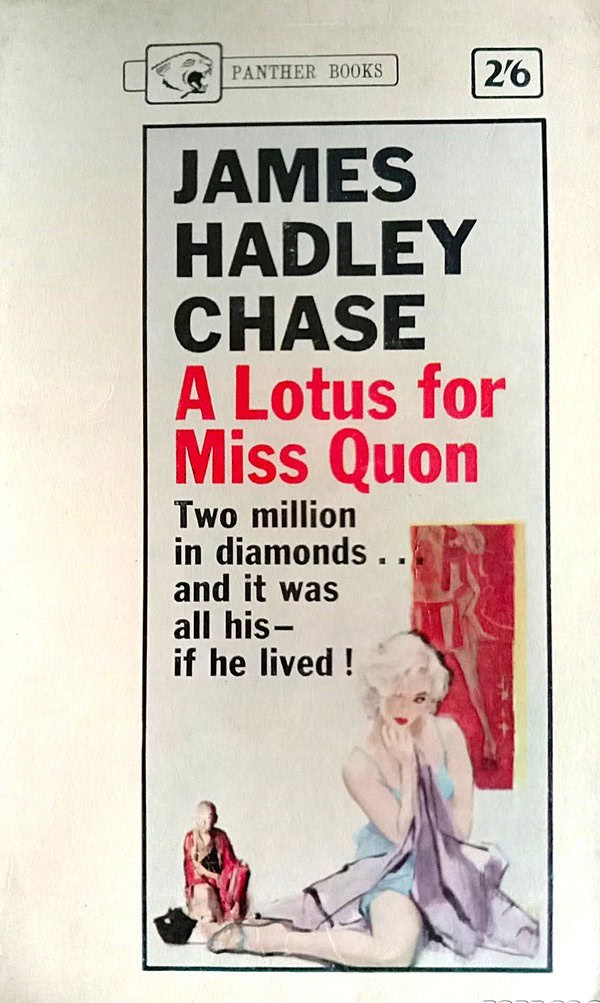
Covers: Chase’s novels were regularly reprinted and enjoyed a range of different styled covers, of varying quality. Some, especially the early 1970s Panther covers, were quite interesting and inventive, but most of the latter ones featured stock standard photographs of partially dressed models that had little or no relevance to the content of the book. A Lotus For Miss Quon seems to have been particularly poorly treated by publishers, and none really stand out. The above 1963 Panther edition, featuring a pale blonde on the cover, is particularly off-key as there are no blondes, or European women for that matter, in the novel. However, leaving that aside it is not a bad generic cover, and is a good representation of the ‘Good Girl Art’ of the period.
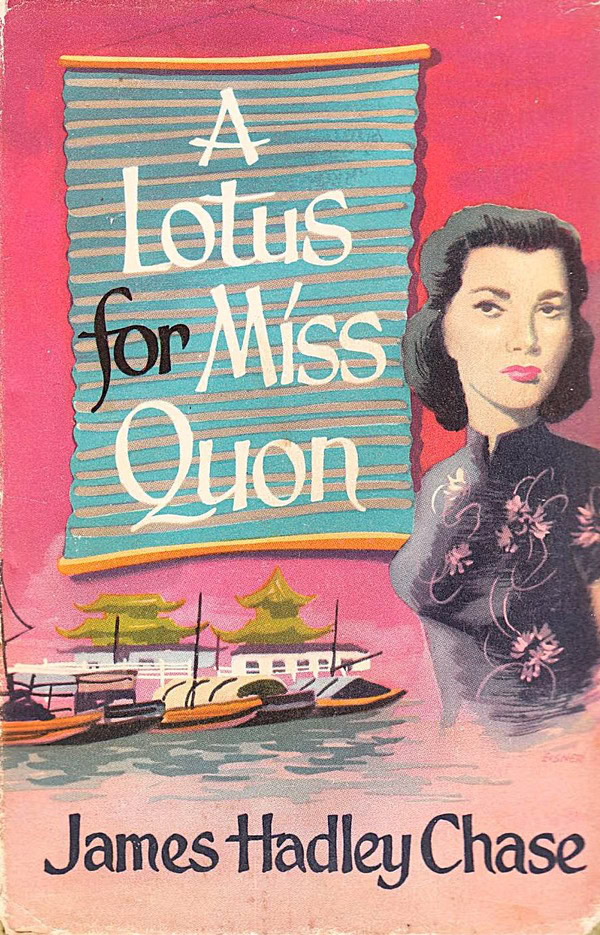
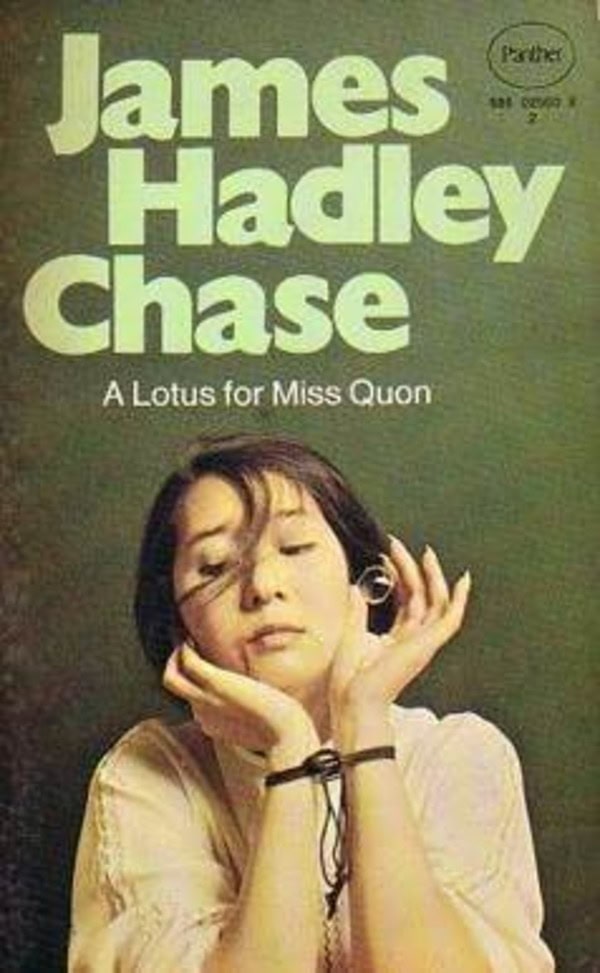
Of the ones I have seen, the below illustration on The Thriller Club Edition (hardback) by A. H. Eisner of a Vietnamese woman with some nondescript boats in the background is probably the most atmospheric of them, although it is not particularly eye catching and gives no sense of the violence of the story. The later photograhic Panther cover from 1970 is also quite bland.
Here are links to some earlier articles on James Hadley Chase’s books and their covers: https://murdermayhemandlongdogs.com/forgotten-crime-one-bright-summer-morning-by-james-hadley-chase/
https://murdermayhemandlongdogs.com/trashy-tuesday-james-hadley-chase-the-panther-covers/