

FORGOTTEN CRIME: FRAME-UP by ANDREW GARVE (1964)
Paul Winterton wrote over forty thrillers and crime novels, mainly under the pseudonym of Andrew Garve, from the early 1950s through to the late 1970s. I can vaguely remember reading a long time ago some of his interesting international thrillers, such as A Hero For Leanda and The Ascent Of D-13, but cannot recall any of his crime novels. I recently came across one of his police detection stories, Frame-Up (1964), and thought that I would give it a go.
Frame-Up is a deceptively simple, but cleverly devised, mystery that revolves around the murder of a rich and eccentric artist. The police quickly identify three suspects, the man’s nephew, his protégé and his attractive housekeeper to whom he has secretly proposed marriage. Each of the suspects have seemingly unbreakable alibis and it is up to Chief Inspector Blair, and his team, to solve the mystery by breaking one of the alibis.
This nicely trimmed down crime novel unfolds at a good pace, and goes through the requisite twists and turns before arriving at a relatively surprising conclusion. Clues are adroitly placed throughout the story, and modern readers will be better placed to guess the outcome than the original audience, as it hinges on the use of technology which now seems commonplace, but at the time was probably groundbreaking.
Unlike modern crime novels, the story is not encumbered by angst and lengthy internal monologues, and the detectives are not hindered by personal problems and addictions. Blair, “with the long eager nose of a greyhound and a thin, sardonic mouth”, is briefly and effectively sketched, as the main suspects. The various women in the story, however, are not described in glowing terms, with Garve using phases such as “sluttish”, “gold digger” and “one of the ugliest female faces (he had seen)”. Not surprisingly, the attitudes are very much of the 1960s, but the book does not have the casual snobbery and racism of Agatha Christie’s novels.
In all, Frame-Up is a good, sprightly paced police detective novel that offers more enjoyment than a lot of bloated modern crime stories and domestic suspense thrillers.
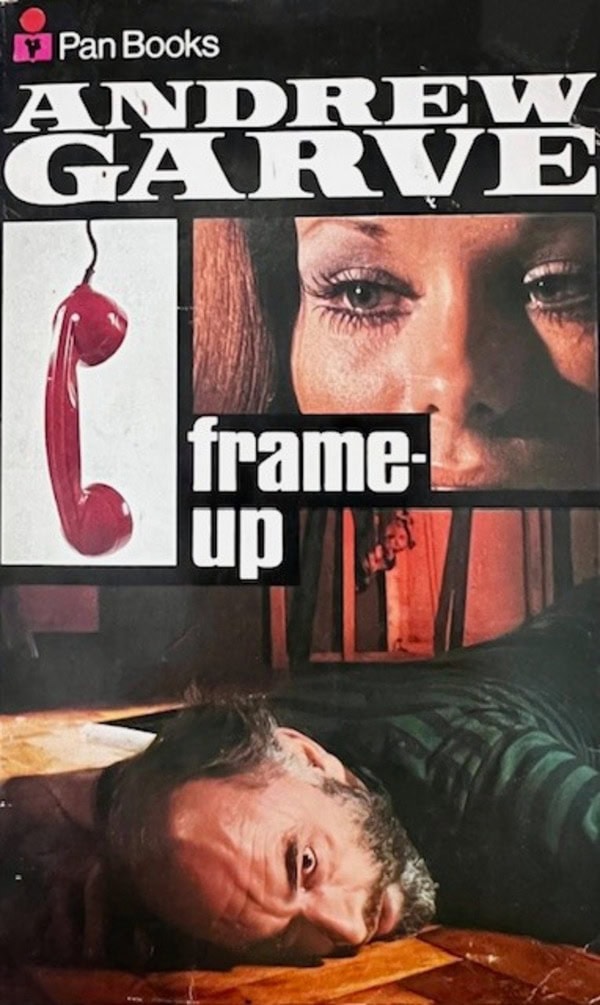
I am not usually a fan of photographic covers, not the above 1972 Pan edition is quite cleverly done. The collage of images nicely captures key elements in the story and plays with the ‘framed’ motif that runs throughout the book.